The practical walk
A day in the garden
A day here is a walk with a few real choices, not a list of rooms to finish. I start from the gate, I let the weather pick the first path, and I leave when the gravel has said enough.
Coming in
You come off the road at Brentwood Bay and the garden starts as a choice of direction. One path drops toward the old quarry. The other stays higher, along the borders, the gravel, and the firs.
I do not rush that first minute. Bright cool morning light can take the open beds. If the cloud is down on the inlet, I take the lower way, where the stone still holds yesterday's rain.
Quarry first, or the borders
Quarry first is the right order when you want scale before detail. You stand on the rim, see the whole floor, and only then walk down into it. The roses feel finer after that, which is a kindness to them.
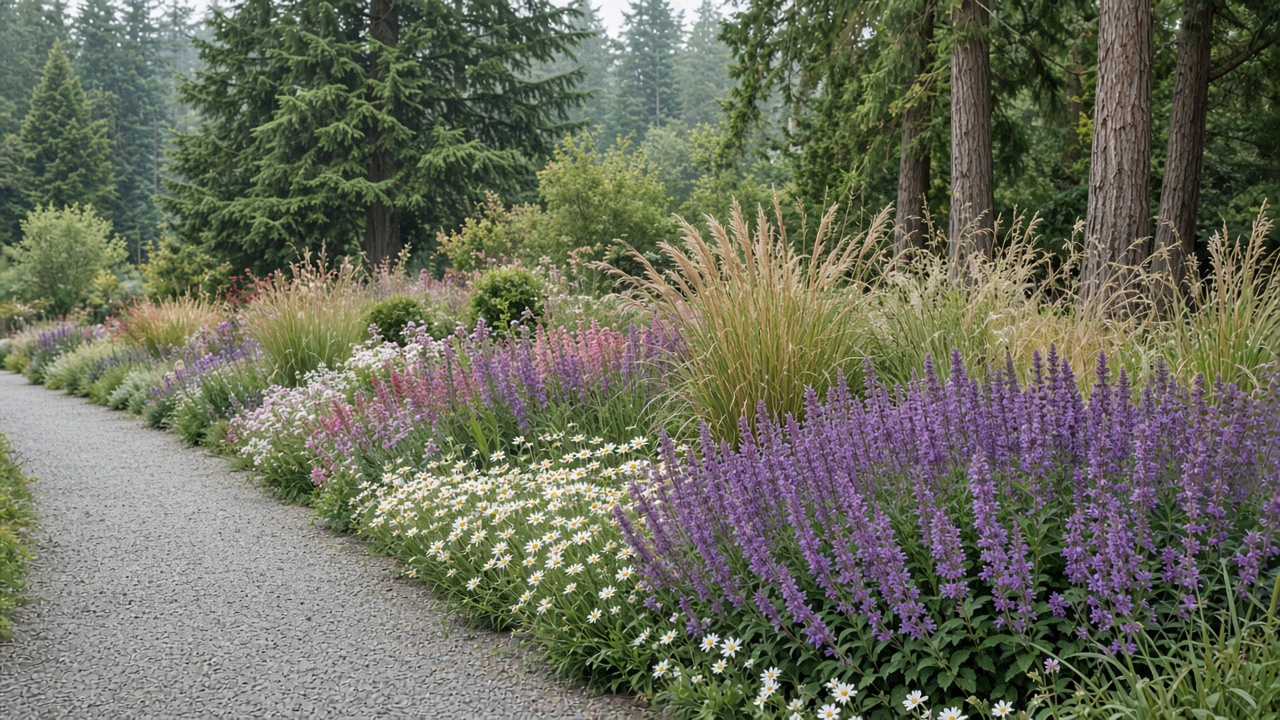
Borders first is the order I use in late summer. Delphinium, phlox, and rudbeckia stand over the gravel, and the Douglas firs make a dark wall beside the path. I want that shade before I commit to the open pit, once the afternoon is already warm.
What the season does to the same paths
Spring is bulbs and rhododendron, and the quarry reads from the rim as separate blocks of colour. Tulips and daffodils hold those blocks until you are among them, where they become single flowers again. Summer fills every gap, and the same view turns into one mass.
Autumn belongs to the maples and to whatever the borders still hold, asters and the last salvia. Winter is rain, hellebore, camellia, and the bones of the paths. I walk shorter then, and I look at stone and evergreen more than at bloom.
Where I sit
I sit on the quarry rim before I go down, while the floor is still a picture and my legs are fresh. The second seat is a bench by the rose arches, once scent is the main fact of the path and the gravel has put heat into my ankles.
The third seat, if the day has one, is at the Japanese pond. That sit is for watching water, not for recovering from the climb. If I only sit once, I pick the rim in spring and the pond in autumn.
The rose walk and the pond
The rose walk is heat, gravel, and a tunnel of arches. You move through scent, and the path feels social even when you are alone, because the flowers are busy. People talk. The corridor expects it.
The pond asks for the opposite. Moss takes the sound out of a step. The bridge is a pause, not a goal, and a red maple over still water will hold you if you let it. If you wanted the noise of the roses, the maple will seem to be doing nothing, and it is.
How long a slow loop takes
A slow loop takes the length of a morning if you sit and look, and the length of a long conversation if you keep moving. I do not count it in minutes. Minutes turn a walk into an errand.
Pass the quarry, the borders, the roses, and the pond without hurrying, and the light will have moved by the time the gate comes back. That shift is the clock. If you are tired before the pond, stop. A forced ending spoils the maple, and the pond will be there on another visit.
The harbour after, and the bay itself
After the garden I like Victoria, when my feet want flat stone instead of gravel. The inner harbour is masts and float planes, and the parliament buildings sit on the ridge above the water. Those lawns are clipped and civic. They feel restful after beds that are trying so hard.
Brentwood Bay is not a door you use and forget. It is a small harbour of its own, boats on Tod Inlet, an evening that goes quiet early. Stay if the light on the water is good. The peninsula does not improve because you rushed south the moment the gravel ended.